 |
GMail vs Microsoft Exchange
September 16, 2023 | Author: Adam Levine
29
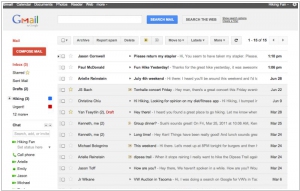
Gmail is an email service provided by Google. Users may access Gmail as secure webmail, as well via POP3 or IMAP protocols. Gmail's spam filtering features a community-driven system: when any user marks an email as spam, this provides information to help the system identify similar future messages for all Gmail users. Google also provides GMail alternative for business - Google Workspace.
20
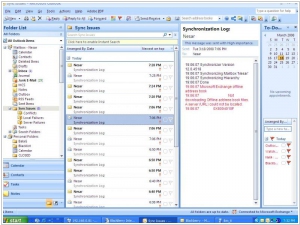
Microsoft Exchange Server is the server side of a client–server, collaborative application product developed by Microsoft. Exchange's major features consist of electronic mail, calendaring, contacts and tasks; support for mobile and web-based access to information; and support for data storage.
Gmail and Microsoft Exchange are both popular email platforms, but they have distinct differences in their features, ecosystem, and target audience. Gmail, offered by Google, is known for its robust and user-friendly interface, spam filtering, and extensive integration with other Google services. It offers features like advanced search, email labels, filters, and generous storage space. Gmail is widely used by individuals and businesses of all sizes, particularly those leveraging Google's ecosystem and cloud-based productivity tools. On the other hand, Microsoft Exchange is an email server solution offered by Microsoft that provides comprehensive email and collaboration capabilities. It offers features like calendar integration, shared contacts, centralized management, and synchronization with Microsoft Outlook. Microsoft Exchange is often favored by businesses using the Microsoft ecosystem and seeking advanced enterprise-level features, security, and centralized control over email accounts.
See also: Top 10 Email services
See also: Top 10 Email services
GMail vs Microsoft Exchange in our news:
2023. Gmail app gets highly requested native translation feature
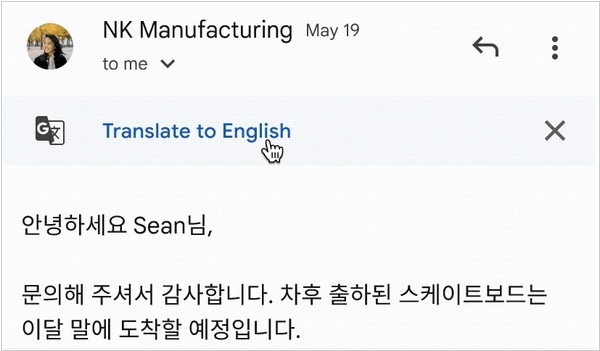
Gmail for Android and iOS are getting an inherent translation function, which can automatically identify the language of an email and provide a translation. This function, which has been a consistent feature on the desktop variant, currently supports 100 different languages. Previously, if users wished to translate an email, they needed to either manually copy and paste the text into Google Translate or capture a screenshot and upload it to Google Lens. To translate a message on mobile devices, users can simply select the "Translate" choice found in the three-dot menu at the upper-right corner of the email interface. Users are able to set their preferred output language in the settings, enabling a prompt to appear whenever an email's content doesn't align with the "Gmail display language."
2022. New Gmail redesign focuces on promoting Meet videoconferencing
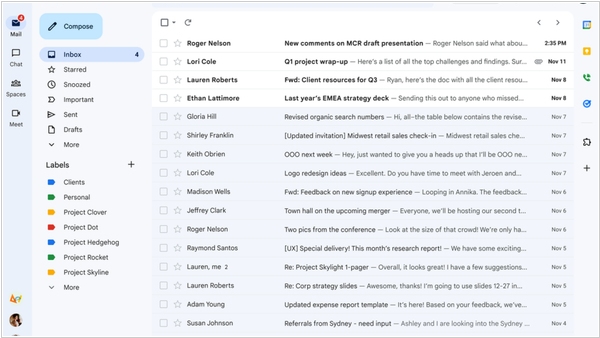
The Gmail update is being rolled out to all users. Google has kept the interface changes minimal, and you can customize the new design using the Quick Settings button located on the top right. The major enhancements include improved integration of Chat, Spaces, and Meet within Gmail, along with more visually appealing and colorful buttons. Beneath the surface, there are also modifications such as the introduction of "search chips" which refer to enhanced and precise search filters, as well as AI-powered search suggestions from Google. The company plans to introduce an enhanced experience for tablet users, improved emojis, and new accessibility features later this year.
2020. Gmail for G Suite gets deep integrations with Chat, Meet, Rooms and Docs

Google is rolling out a significant update to its G Suite productivity tools today, introducing a seamless integration of Gmail, Chat, Meet, and Rooms across web and mobile platforms. Additionally, popular tools like Calendar, Docs, Sheets, and Slides will also be deeply integrated. Google refers to this initiative as a "better home for work," offering enhanced product integration. Users can expect features like integrated calendaring and file management within Gmail, as well as the ability to simultaneously engage in real-time document collaboration while conducting a video chat in a split-screen view. Currently, these updates are specific to G Suite, but Google has plans to extend this integrated workspace experience to consumers, similar to its efforts with bringing Meet to a broader audience. The exact details of this consumer offering, however, are yet to be revealed.
2020. Google brings Meet to Gmail on mobile

Google has recently integrated its Meet video conferencing service directly into the mobile version of Gmail. Users of Gmail on Android or iOS now have the convenience of joining Meet meetings directly from their inbox when someone sends them a Meet event link. This eliminates the need to install the dedicated Meet app solely for joining calls via Gmail. Within the Gmail app, a new Meet tab will appear at the bottom of the screen. This tab will display all upcoming Meet meetings from Google Calendar, allowing users to initiate a meeting, obtain a shareable link, or schedule a meeting within the Calendar. If you prefer not to have the Meet tab visible, you also have the option to disable it.
2019. You can now attach emails to other emails in Gmail
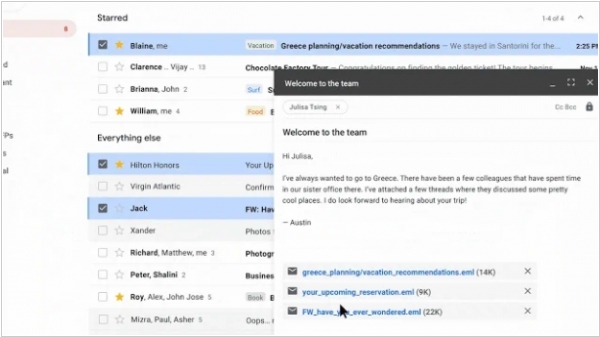
The latest feature in Gmail allows users to attach an email or an entire email thread to another email. This functionality proves to be more convenient in certain scenarios compared to forwarding multiple individual emails. To utilize this feature, users can initiate a new email and simply drag the subject line from the list of emails. The software will automatically recognize it as a potential attachment. The attached emails will be converted into ".eml" files, and there is no restriction on the number of emails that can be attached.
2019. Gmail now allows to schedule emails
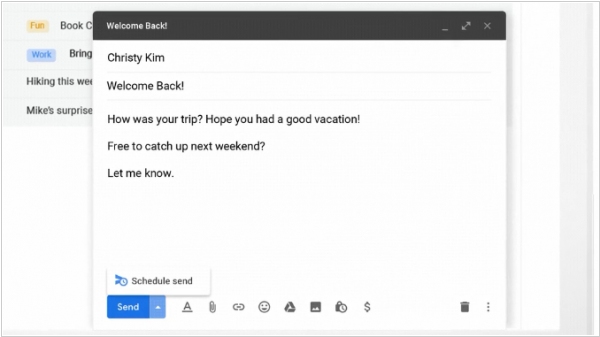
Google has introduced a new feature in Gmail that allows users to schedule their drafted emails to be sent at specific times in the future. While one might assume that Gmail already had this functionality, its addition is still likely to be well-received. Furthermore, Google has announced expansions to the popular Smart Compose feature in the email client. Smart Compose now has the capability to better emulate the user's writing style, particularly when it comes to informal greetings in emails. Additionally, Google states that Smart Compose can now suggest subject lines. Moreover, Smart Compose has been extended to support Spanish, French, Italian, and Portuguese, in addition to English, and is compatible with Gmail for Android.
2019. Gmail makes emails more dynamic with AMP for Email
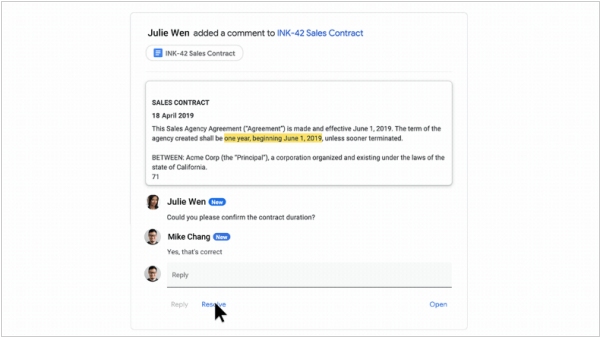
Google has introduced AMP for Email, a revolutionary initiative aimed at transforming static emails into dynamic, web page-like experiences. While initially available in Gmail, other prominent email providers such as Yahoo Mail, Outlook, and Mail.ru will also support AMP emails. AMP for Email holds the promise of elevating ordinary messages into interactive platforms that enable users to accomplish tasks directly within their web-based email client. With AMP for Email, users can engage with messages in a whole new way. For instance, you can RSVP to an event, complete a questionnaire, browse a store's inventory, or respond to a comment without leaving your email interface. This groundbreaking format has gained support from several notable companies including Booking.com, Despegar, Doodle, Ecwid, Freshworks, Nexxt, OYO Rooms, Pinterest, and redBus. The format incorporates various popular AMP markup features like carousels, forms, and lists. It's worth mentioning that these AMP messages also include standard HTML markup as a fallback for email clients that do not support AMP.
2019. Mobile Gmail gets Material Design UI
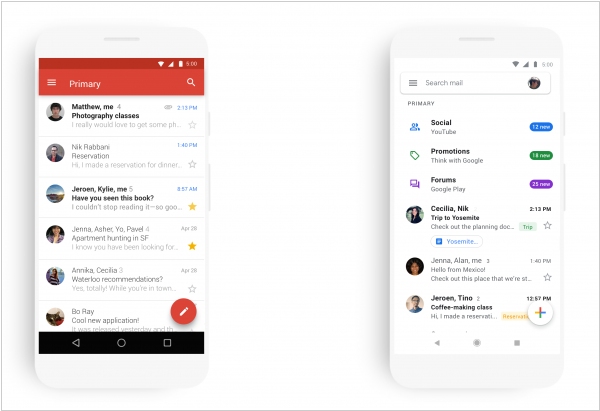
Gmail for mobile (available on iOS and Android) is receiving an updated appearance that aligns with the recent Material Design enhancements made to Gmail, Drive, Calendar, Docs, and Sites by the company. Users will notice a familiar UI reminiscent of the Gmail web app, including the option to select from three different density styles. Additionally, there will be new fonts and visual refinements. In terms of functionality, the mobile app is gaining several new features that bring it on par with the web version. Similar to the desktop experience, users can now choose between the default view, as well as comfortable and compact styles. Google has also improved the account-switching process, making it more convenient. Another noteworthy addition is the inclusion of the large red phishing and scam warning box, which was previously available only in the web version, now appearing in the mobile app as well.
2018. Gmail’s iOS app gets a unified inbox
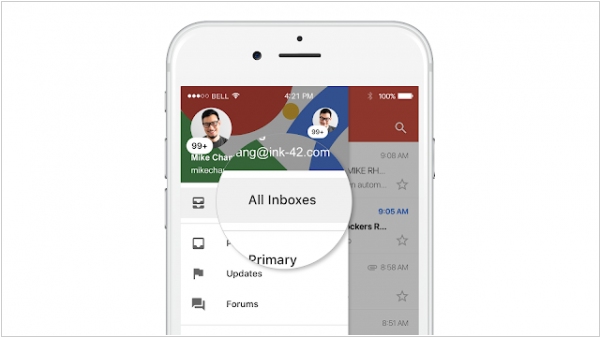
In today's digital landscape, individuals often manage multiple email accounts, dividing them between work and personal use. While Android users of Gmail have long enjoyed the convenience of viewing multiple inboxes in a single interface, iOS users have been limited to switching between accounts within the app's navigation. However, with the latest iOS update, Gmail introduces a new "All Inboxes" view accessible from the left-hand side drawer. This feature is compatible with both G Suite and non-G Suite accounts, including third-party IMAP accounts. Although a unified inbox may seem like a small addition, it addresses a significant pain point that has led many Gmail users on iOS to seek alternative third-party email applications.
2018. Microsoft released Exchange 2019, but no way to deploy it
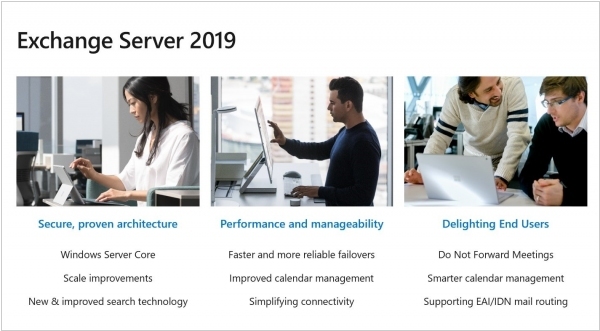
Microsoft has recently launched a fresh iteration of its email and collaboration server, Exchange 2019. Although the update is available for download, there is a hindrance—installation is currently impossible. The reason being that it exclusively operates on the server operating system Windows Server 2019, which is yet to be released. In terms of Exchange 2019's innovations, they primarily revolve around enhancing system performance. The latest version has the capacity to utilize up to 48 processor cores and 256GB of RAM, with optimizations specifically tailored for SSD drives. It is evident (and Microsoft openly acknowledges this fact) that Exchange is being developed with a primary focus on large and exceedingly large enterprises. Consequently, Microsoft aims to transition small and medium-sized businesses to their cloud-based offering, Microsoft Office 365, which delivers email server functionality as a service.